CMS reported today that health spending is indeed rising faster than than the overall economy once again. Health care spending as a percentage of GDP rose to 17.8% in 2015.
12/2016
12/2016
The current era of ultralow growth in health care spending may be over. The Centers for Medicare & Medicaid Services has issued a report that projects total healthcare spending to increase an average of 5.8 percent per year during the period 2014 through 2024. The good news is that this is less than the 9 percent average seen in the three decades leading up to 2008.
9/2015
9/2015
According to information published in The Journal of the American Medical Association, the first two enrollment periods of the Affordable Care Act (ACA) were associated with significant improvements in such important health care metrics as insurance coverage, access to primary care and medications, affordability, and health. Study authors found decreases in the following metrics by the first quarter of 2015:
8/2015.
- Number of uninsured—down 7.9 percent
- Individuals who lacked a personal physician—down 3.5 percent
- Individuals who lacked easy access to medicine—down 2.4 percent
- Individuals who were unable to afford care—down 5.5 percent
- Individuals who reported fair/poor health—down 3.4 percent
- Percentage of days with activities limited by health—down 1.7 percent
8/2015.
A new report from the Commonwealth Fund shows how families continue to be squeezed by health care costs. The cost of premiums for family coverage increased 73 percent over the past decade—much faster than median family income. Furthermore, employees’ contributions to their premiums climbed by 93 percent over that same time frame. At the same time, deductibles more than doubled in both large and small firms. Workers are thus paying more but getting less protective benefits. Read the report and view related graphics here
1/2/2015
While the number seems high to us, it's been widely reported that 40% of commercial in-network payments this past year were "value-based". This is a huge jump from the previous estimate of 11%.
12/31/2014
The incidence of often-deadly ailments that patients fall prey to inside U.S. hospitals fell by 17% between 2010 and 2013, the Obama administration reported this year. These ailments include infections, falls and adverse reactions to drugs. The administration estimates that the decline resulted in as many as 50,000 fewer people dying while hospitalized over the three-year period between 2010 and 2013.
Score one for paying for value!
12/31/2014
The rate of paid medical liability claims against doctors has been steadily dropping for a decade now. Between 2002 and 2013, the rate for MDs decreased from 18.6 to 9.9 paid claims per 1,000 physicians.
11/25/2014
1/2/2015
While the number seems high to us, it's been widely reported that 40% of commercial in-network payments this past year were "value-based". This is a huge jump from the previous estimate of 11%.
12/31/2014
The incidence of often-deadly ailments that patients fall prey to inside U.S. hospitals fell by 17% between 2010 and 2013, the Obama administration reported this year. These ailments include infections, falls and adverse reactions to drugs. The administration estimates that the decline resulted in as many as 50,000 fewer people dying while hospitalized over the three-year period between 2010 and 2013.
Score one for paying for value!
12/31/2014
The rate of paid medical liability claims against doctors has been steadily dropping for a decade now. Between 2002 and 2013, the rate for MDs decreased from 18.6 to 9.9 paid claims per 1,000 physicians.
11/25/2014
A new Commonwealth Fund report "finds that the U.S. ranks last overall on measures of health system quality, efficiency, access to care, equity, and healthy lives" when compared with other industrialized countries. This is in spite of our vastly outspending these other countries.
9/30/2014
9/30/2014
2014's Message to the Public from our Social Security and Medicare Trustees estimates that the Medicare program will run out of money to pay all its hospital bills by 2030. This is 4 years later than last year's estimate reflecting a slowdown in rising health care costs to the program. While it is not known what is suppressing rising costs, some provisions of the Affordable Care Act are likely partly responsible.
9/10/2014
9/10/2014
According to Towers Watson's annual survey of employer sponsored insurance, our patients continue to pay more for their health care, and affordability is becoming a greater issue. "Employee affordability issues are a growing challenge. Employees’ share of premium costs increased nearly 7% in the last year, from $2,782 to $2,975. Out-of-pocket expenses also continue to increase, by nearly three percentage points over the last four years (from 15.9% to 18.7%). Total employee cost share, including premiums and out-of-pocket costs, has climbed from 34.4% in 2011 to 37% in 2014."
Due to cost shifting, moderating health care costs often are not being passed along to average Americans.
3/6/2014
'
Due to cost shifting, moderating health care costs often are not being passed along to average Americans.
3/6/2014
'
More than 6 million Americans have now either signed up for private health insurance through the different marketplaces or for Medicaid coverage, according to the White House. More importantly, it appears that younger and healthier Americans are applying in sufficient numbers to maintain a viable insurance pool. However, due to the now infamous technical problems with the Marketplace website, enrollee numbers continue to lag expectations. Federal officials plan a significant marketing push to increase numbers by the end of open enrollment on March 31.
1/18/2014
1/18/2014
Are you looking for a higher quality or more patient centered hospital experience? Check out this resouce: whynotthebest.org. Here you can compare hospitals on various quality measures and patient satisfaction results. This type of data allows us to become better and smarter healthcare consumers.
9/01/2013
9/01/2013
The content is still skimpy but will quickly become more robust due to reporting requirements in the Affordable Care Act. Check out this website run by Medicare to gain objective information about various doctors in your area. Quality measures and patient satisfaction rates will be added over time.
7/4/2013
7/4/2013
An unprecedented slowdown in health care spending in the U.S. has continued for 4 straight years now. The reasons for this easing in spending growth are not yet known. Likely causes include our recent recession, structural changes occurring within health care systems, and reforms put in place by the ACA. Whatever the reason, this is quite good news for all Americans. The news was particularly good for Medicare where spending increased by only .4% per beneficiary.
2/12/2013
2/12/2013
As of Oct. 1, Medicare is now paying for performance at our nation's hospitals. Both processes of care and patient satisfaction will be measured. This is a big breakthrough and continues to align payment structures with patient centered care.
The American College of Surgeons released a study today that showed that 1 in 7 surgeries resulted in complications. They stressed the need for patient education to help reduce this high complication rate.
10/2/12
10/2/12
Researchers publishing in Health Affairs found that adults in 2010 were 66 percent more likely to report unmet medical needs than in 2000, 79 percent more likely to have unmet dental needs, and were also more likely to have delayed treatment for needed medical care.
The deterioration of access was worst among the uninsured. But access deteriorated for insured patients as well. By 2010, 10.2 percent of Americans with private insurance reported having unmet medical needs, vs 5.8 percent in 2000. The number of privately insured who delayed care because of costs also climbed, to 6.8 percent from 3.9 percent. Click link above for abstract.
5/15/12
The deterioration of access was worst among the uninsured. But access deteriorated for insured patients as well. By 2010, 10.2 percent of Americans with private insurance reported having unmet medical needs, vs 5.8 percent in 2000. The number of privately insured who delayed care because of costs also climbed, to 6.8 percent from 3.9 percent. Click link above for abstract.
5/15/12
A new study shows that hospitals are paying greater attention to preventing infections due to Medicare's refusal to pay for certain preventable hospital acquired infections. This has resulted in better efforts to reduce such infections. Pay for performance works.
5/15/12
5/15/12
Is your doctor always honest with you? Apparently not. According to a study in Health Affairs, doctors often don't admit their mistakes, disclose financial arrangements with other providers, or tell the whole truth about patient prognosis and treatment choices. Without full disclosure, patients cannot make informed treatment decisions, and they may not do what is in their best interests.
3/6/2012
3/6/2012
The United States Senate and the Justice Department are both reviewing Medtronic's synthetic bone graft, Infuse. It is currently used in about half of the 80,000 anterior lumbar bone fusions performed each year in this country. A report authored by Dr. Eugene Carragee in the Spine Journal (available by subscription) confirmed that some of the 13 Medtronic-sponsored studies of Infuse had failed to properly disclose complications.
In an editorial accompanying the new study, Dr. James Kang of the University of Pittsburgh wrote that industry support was perhaps the best way to explain the different conclusions reached by Dr. Carragee and the Medtronic-sponsored researchers. “There does not seem to be any rational explanation for these observational differences,” Dr. Kang wrote. Of note, the physicians who perform industry studies generally are paid millions of dollars in royalty or consulting fees. One must wonder, what exactly are they paid to do?
6/22/11
In an editorial accompanying the new study, Dr. James Kang of the University of Pittsburgh wrote that industry support was perhaps the best way to explain the different conclusions reached by Dr. Carragee and the Medtronic-sponsored researchers. “There does not seem to be any rational explanation for these observational differences,” Dr. Kang wrote. Of note, the physicians who perform industry studies generally are paid millions of dollars in royalty or consulting fees. One must wonder, what exactly are they paid to do?
6/22/11
Graphic illustration of the problems with America's healthcare system
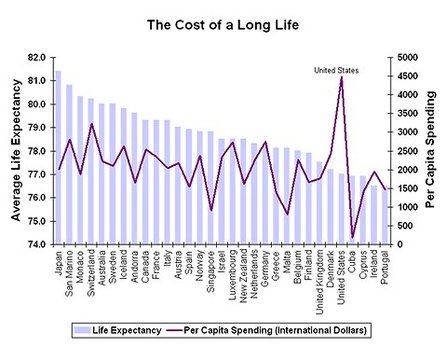
Taken from UC Santa Cruz's Atlas of Inequality, the US ranks just ahead of Cuba in life expectancy while spending vastly more than any other country. Only large-scale systemic reforms can improve this situation.
A new survey reveals that orthopedic surgery was the most lucrative specialty in American medicine last year. The median income for orthopedists was $515,000. Again, trailing far behind was family practice with a median income of $189,000. Furthermore, orthopedic surgeons generally supplement their practice income with revenue derived from ownership positions in imaging centers, physical therapy, or surgery centers--an opportunity generally not available to primary care physicians. Click here to view report and then open PDF. Looking at these numbers, how can we not have an intractable problem steering new doctors into primary care fields? How can specialists claim that they cannot afford to treat Medicare or Medicaid patients?
6/17/2011
6/17/2011
The CDC has released its first report detailing racial and socioeconomic disparities in Americans' health. Among other findings are these:
1/13/11
- Babies born to black women are up to three times as likely to die in infancy as those born to women of other races.
- Young American Indian adults have the highest suicide rate of any group by far.
- The poor, the uninsured and the less educated tend to live shorter, sicker lives.
- Rates of preventable hospitalizations increase as incomes decrease.
1/13/11
According to a study by the Center for Studying Health System Change, community based, private practice physicians own or lease advanced imaging equipment and in-office invasive surgery equipment as follows:
1/12/11
- 25.2 percent reported owning or leasing equipment for laboratory services
- 17.4 percent reported owning or leasing advanced imaging equipment, such as CT or MRI machines
- 28.9 percent reported owning or leasing equipment for non-invasive procedures
- 11.4 percent reported owning or leasing equipment for for invasive procedures, such as cardiac catherization
1/12/11
Geoffrey Spurling and colleagues have published a study looking at the $57.5 billion that pharmaceutical companies spent on drug promotion in the United States in 2004. Their conclusion: "With rare exceptions, studies of exposure to information provided directly by pharmaceutical companies have found associations with higher prescribing frequency, higher costs, or lower prescribing quality ..." They recommend that doctors have no contact with pharmaceutical salespeople.
11/01/10
11/01/10
Joblessness and the accompanying loss of health benefits drove an additional 3.7 million people into state Medicaid programs last year according to an annual survey by the Kaiser Family Foundation. Enrollment in the programs grew by 8.2 percent from December 2008 to December 2009, the second-largest rate of increase in the 10 years that Kaiser has conducted the survey. There were 48.5 million people on Medicaid at the end of 2009, or about one of every six Americans.
10/8/10
10/8/10
Researchers publishing in The Archives of Internal Medicine "found a massive, dramatic system failure" when studying orthopedists who were all paid more than $1 million by medical device manufacturers but who then routinely failed to disclose this conflict of interest in their articles in medical journals. The medical journals all promise stricter guidelines concerning conflicts of interest. See this review article in the New York Times if you don't have a subscription to the Archives.
9/16/10
9/16/10
The authors of America's first-ever national random-sample survey of bankruptcy filers published their findings in this month's issue of The American Journal of Medicine. The survey found that over 62% of our country's bankruptcies are due to a medical cause. Three quarters of bankruptcy filers had active health insurance and most were members of our middle class. Furthermore, the share of bankruptcies attributable to medical problems rose by 50% between 2001 and 2007. 6/13/09